Paul Newsman

The go-to place for self-written spoof news in German-speaking countries — and, since the relaunch, a Next.js application with an AI newsroom, its own editor and a section built for the classroom.
Idea, development and operation: me.
paulnewsman.com ↗- Articles
- 180,000+
- Reads
- 4 million+
- Teachers
- 330+
What it is
On Paul Newsman you write invented newspaper articles that live on their own magazine domains and look like real online papers — from the Kölner Abendblatt to Grätsche. Even the link preview looks convincing when shared; a disclaimer sits under every article.
What started as a prank for the family group chat became teaching material: teachers at universities, grammar, secondary and primary schools use it to show how quickly a believable piece of fake news comes into being.
Timeline
- 2016
- The idea in April, then nine months of evenings building it.
- 2017
- Paul Newsman goes online in January.
- 2024
- In April, feedback collected from the teachers — and the rebuild starts.
- 2026
- 1 August: the big relaunch — rebuilt on Next.js, with an AI newsroom.
What went live on 1 August 2026
The survey set the agenda: AI, please — there is no time to type long texts in a school day. Let the pupils join in. Material, not just a tool. And: more papers. All four are in.
- 01
Rails to Next.js 16
Ten years of articles and every magazine domain moved across without breaking a single URL.
- 02
AI newsroom, two ways in
Pick a template or type your own idea; the article appears word by word, image suggestion included.
- 03
Credits instead of a subscription
You pay for what you use — writing by hand stays free, forever and for everyone.
- 04
Lessons for whole classes
Verified teachers open a lesson; the class joins by link, QR code or a short code on the board.
- 05
Six papers, one of them new
New mastheads and layouts across all domains — plus the Freizeit Echo, the gossip paper of the group.
- 06
A press pass and a voice
Nine ranks to climb, and every article can be read aloud — for the bus, for reluctant readers, for accessible lessons.
Six papers, six domains
Every paper is its own publication with its own masthead, typography and domain — technically all six are one Next.js application. A magazine module per paper holds what makes it different, and the proxy keeps those domains session-free: they serve articles, nothing else.






For teachers
Talking about fake news is one thing; building one yourself works considerably better. A verified teacher opens a lesson and shares a join link, a QR code or a short code on the board — no accounts, no email addresses, no app. Whether the class writes under pool names or their own is the teacher's decision.
“If children are made aware of this back in primary school, it will help a lot of them later on.”
Nothing goes public without a click of approval, and the teacher watches every article as a stack with live statistics — the view count ticking up mid-lesson is the moment that lands. Writing by hand is free; credits are only needed for AI and narration, they always come out of the teacher's pocket, and verification brings 30 of them as a gift.
The press pass
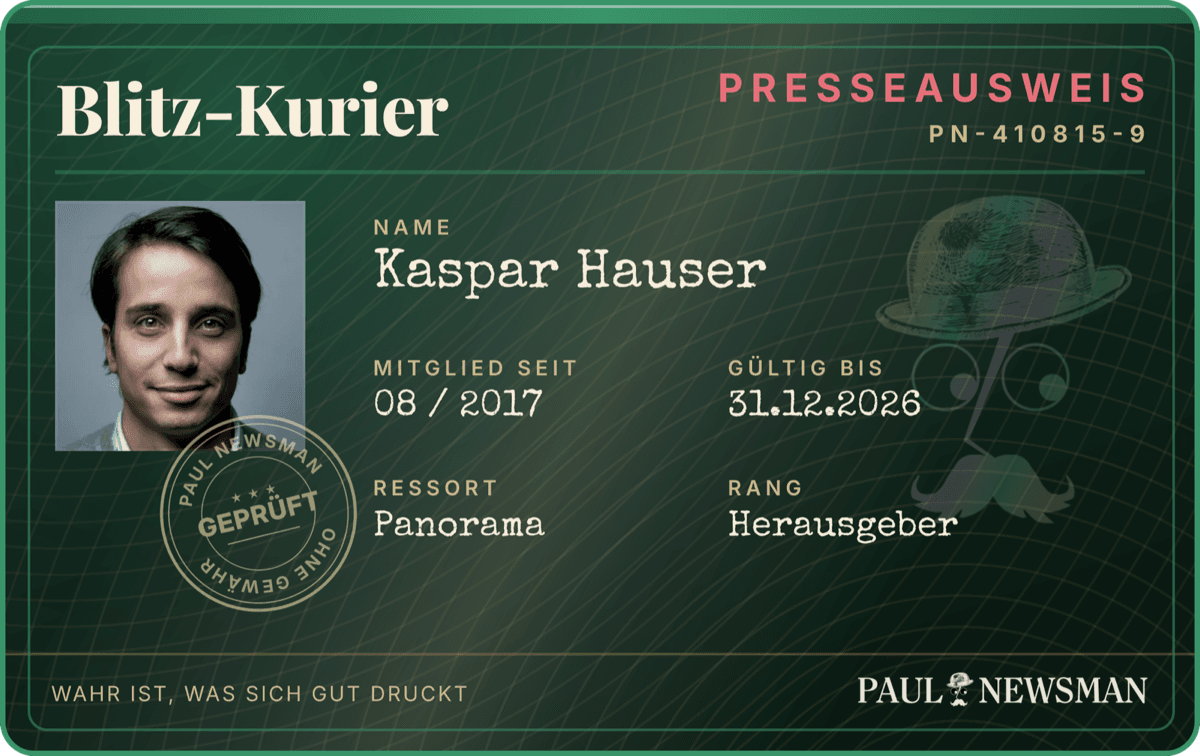
Everyone carries a press pass: nine ranks from trainee to publisher, in three leagues, each stage a finer material than the last. It cannot be bought — only earned by taking part. Click the card and it turns around, with the small print on the back: the pass “entitles the holder to absolutely nothing”.
168 faces
Instead of photo uploads there is a gallery: 168 avatars in four categories — characters, animals, women, men — in twelve colours. Drawn by AI, then hand-tuned for days, and delivered as SVG so they stay sharp at any size.
The generator is deterministic on purpose: same input, byte-identical output, no random numbers and no timestamps. A handful of figures also exist as talking variants with three mouth states — the mimicry runs on CSS alone, without a single frame loop in JavaScript.







“Wahr ist, was sich gut druckt.”
“True is whatever prints well” — one of the slogans you can put on your press pass
Details worth the trouble
- Editor
- 120 characters of headline, 20,000 of text, eight million searchable photos with automatic credits — and a freely chosen article date.
- Migration
- Ten years of content and every magazine domain moved from Rails to Next.js without losing a URL.
- Domain routing
- One application serves six magazine domains; the proxy keeps them session-free and limited to articles.
- Streaming
- Generated articles arrive word by word instead of after a spinner.
- Narration
- Any article can be read aloud, in the language of the page.
- Press pass
- Rendered on the server at print resolution — a browser screenshot would fray the guilloche pattern.
- Avatars
- 168 hand-tuned SVGs from a deterministic generator, talking variants included.
- Responsibility
- Every article starts private, carries a disclaimer, and is never more than two clicks from the explanation.
As seen in the press
Paul Newsman has been covered by Süddeutsche Zeitung, WDR, NDR, Bild, Correctiv, Mimikama and BuzzFeed, among others. Some articles are still being debunked as satire seven years on, because they refuse to stop circulating.
Built with
- Next.js 16
- React 19
- TypeScript
- Tailwind CSS 4
- Supabase
- Vercel AI SDK
- TipTap
- Lemon Squeezy
- Cloudflare Images
- Sentry
- Plausible CE
Hosted on Vercel, analytics through self-hosted, cookie-free Plausible.